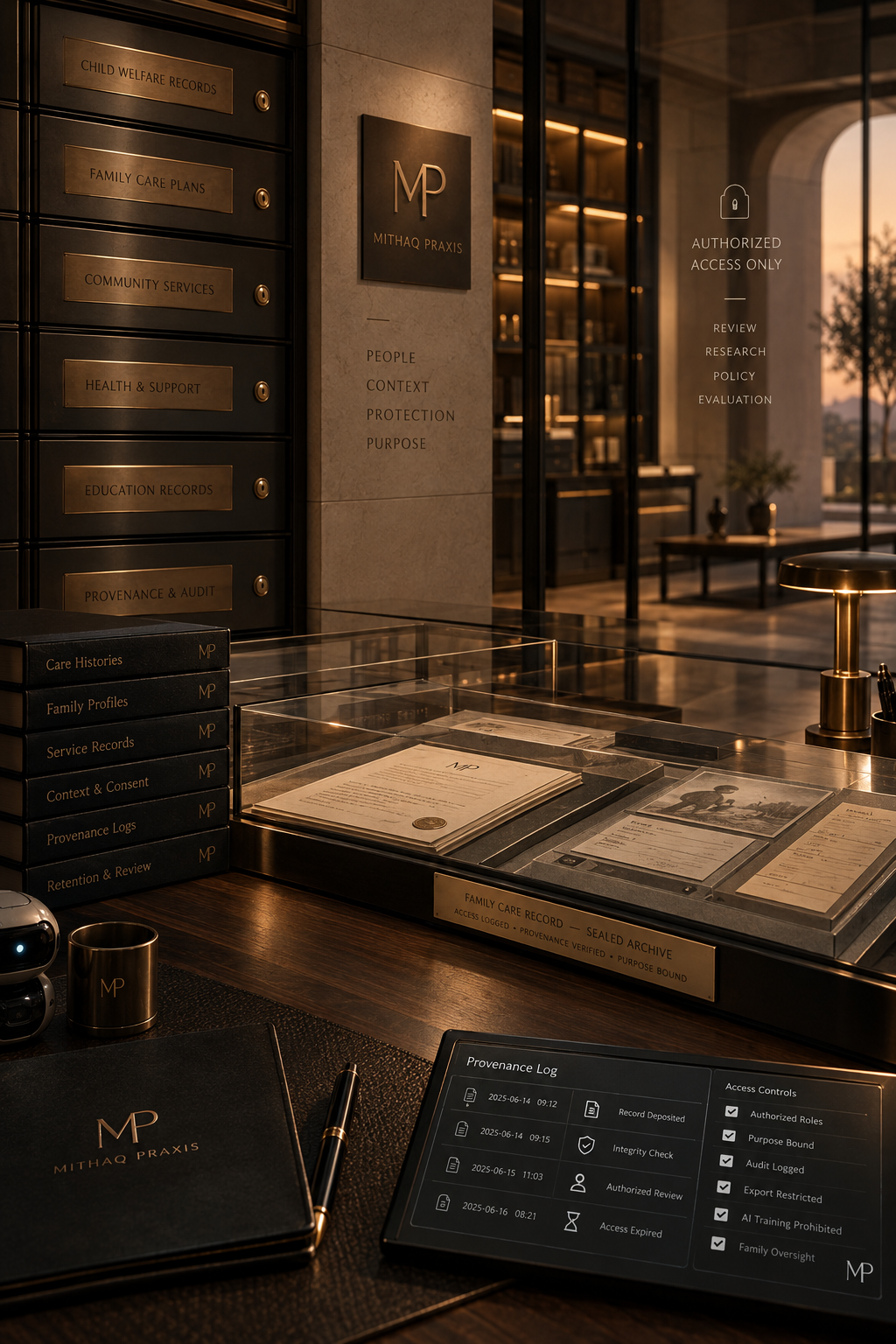
Memory needs judgement · Illustrative research visual
Orientation05 / 06
Why this pathway exists
The continuity layer sits outside any one model and treats provenance, consent, purpose, context, review, expiry, deletion, portability, and provider exit as architecture.
Continuity needs memory, but collection is not care. Vulnerable people can be made unusually legible while retaining little power over what was captured, inferred, shared, trained on, or kept.
Phase One establishes a research position. It does not claim a deployed care system, clinical authority, or a finished product.
Source trace remains visible
Authored sequence6 papers
The papers in this pathway
Open the memo before leaving the atlas.
The memos are editorial guides derived from the published papers. The originals remain canonical.
015 May 2026 · Supporting sequence
Why Disabled Children’s Data Must Not Become AI Training Sludge
These are conceptual studies—not documentary photographs, production screens, or claims of deployment.
01Memory needs judgementResearch visual02Source trace remains visibleResearch visual03Small, governed memoryResearch visual04The right to reviseResearch visual
Research remains openPhase Two inquiry
Questions carried forward
What this folder does not pretend to settle.
01
What is the smallest memory that still preserves continuity?
02
How can deletion and “do not interpret” rights survive provider changes?
03
What evidence would show that a bounded module is safer in actual use?
Collaborate with usCareful inquiry
Bring another form of knowledge
Bring perspective to the work.
We welcome careful dialogue concerning Disabled people and families, privacy and child-rights researchers, data-governance specialists, security and AI-safety practitioners, and public-interest technologists.
Please do not send children’s records or sensitive care data in an initial enquiry.
Begin with the research question and the perspective you bring.